Are You Reproducing What Was Reproduced in You?
Jun 22, 2026
For the first 10 or 12 years of my ministry career, I believed something I'd been taught my whole life: "Ministry isn't what you do. It's who you are."
It's a common sentence spoken in ministry circles. You've probably heard it. Heck, you may have said it. Most pastors I know nod along when they hear it, as if it's common knowledge. It sounds like calling. It sounds like devotion. It sounds like the kind of total commitment a serious follower of Jesus is supposed to offer. It sounds almost... holy, huh?
But I want to say something I wouldn't have had the courage to say twenty years ago.
That sentence might be sinful.
It was for me.
I used it to justify late nights I shouldn't have worked. Interruptions I should have ignored. Being physically present but emotionally three states away from Cindy and the boys. I lived "on" all the time because I'd been taught that's what ministry required. Anything less was disobedience. And anytime my family pushed back or balked, I'd tell myself they just didn't understand my calling. If they understood, they'd adjust. After all—this is ministry.
That's such nonsense.
It took me longer than it should have to see it. And here's the part that humbles me. I didn't see it. Other people saw it. People who loved me. People who paid the price for my conditioning. People who had been quietly adjusting around my absence for years while I called it faithfulness. Eventually, your blindness becomes embarrassing. Or at least mine did.
What We Were Conditioned to Believe Is Normal
I hear stories like mine almost every day. Pastors who reach out when prevention is already off the table, and intervention is the only option left. Most of them believed some version of the lie I believed. That nothing was actually wrong. That this is just what ministry looks like. That they were fine.
Why does it take pain before any of us choose ourselves? I think it's because the conditioning runs deeper than we realize. And we've been galvanized by it—not in a good way.
Most people in ministry didn't decide to live this way. They were formed into it. Squeezed. Shaped. Because somebody modeled it for them. Probably somebody they respected. Even admired. And they spent their early careers blindly believing what they were handed rather than asking whether it was actually good in the first place. You can't ask those questions, right?
So instead, self-destruction got renamed sacrifice. Exhaustion got labeled calling. Distance from your family was defined as the cost of ministry.
Different language. Same disease.
The conditioning is invisible to the conditioned. I didn't see it. The pastor calling exhaustion "calling" doesn't see it either. We just see ministry. We see how it's done. We see what we inherited. And we hand it down without examination because handing it down feels biblical. Maybe even discipleship. Or mentoring.
Why Pastoral Leadership Development Often Fails
A few weeks ago, my friend David and I were talking about our almost forty years in ministry. He's walked a different path than I have. We arrived at similar places anyway. And in the middle of that phone conversation, he asked the question we're both wrestling to comprehend: "Tim, how did we learn to do this differently?"
I didn't have a clean answer then. And I still don't. The honest version is that I just knew what I was doing wasn't working, and eventually I was willing to ask the questions that made other people uncomfortable. Mostly because they were the questions I'd been refusing to ask myself.
But most ministry leaders never get that interruption. They inherit the model and accept it as gospel. And then—because they're good leaders, because they're committed, because they really do want to multiply ministry—they start reproducing themselves in the next generation. They apprentice protégés of their own and pass on what was handed to them.
But here's the question almost nobody asks: What kind of leaders are we actually producing?
As my friend and colleague Jim likes to say, success is successors. The leaders I admire most are doing exactly that work. But only if the successors are healthier than we are. Otherwise, we aren't multiplying ministry. We're franchising dysfunction.
If the leaders you develop end up with the same anxiety you have. The same drivenness. The same inability to be off. The same conviction that ministry is who they are instead of what they do—then you've succeeded at something. It's just not what you think.
You've reproduced the version of you that hasn't been challenged. The version that still believes the lie. The version that thinks rest is for people with a lesser sense of calling or commitment to Christ.
Listen, that's not multiplication. That's contamination. And the cycle goes on for another generation.
The Only Person Who Never Had a Messiah Complex
Most pastors have a Messiah complex they don't recognize. They think it's calling. They think it's faithfulness. They think it's what you do when you take ministry seriously. It isn't.
The only person who never had a Messiah complex was the Messiah.
He took naps. He went off alone. He turned crowds away. He let people leave disappointed. He set boundaries that frustrated the people closest to him. He worked a three-year ministry instead of a forty-year one and trusted that the people he poured into would carry it forward. The Messiah didn't try to be the Messiah every minute of every day. He was secure enough not to.
And we—who are not the Messiah—somehow got taught that the always-available, always-carrying, always-saying-yes pastor is what faithfulness looks like. But that image has more in common with American business culture than it does with the actual Jesus we claim to follow. We're reproducing it anyway. In our staff. In our protégés. In our kids who are watching us and learning what ministry costs. But it makes sense. Because we inherited it from mentors who also inherited it... and so it goes.
Learning to Listen Is How the Cycle Breaks
Sunday was Father's Day. And it has become the catalyst and culmination of the thoughts for this piece. Now, I love my dad dearly. That's the starting point, not a qualifier. But the man who modeled ministry for me up close also modeled some of what I've spent the rest of my life refusing to repeat. That's not a tidy sentence. It carries love and awareness at the same time. Both things are true simultaneously.
Some of what I watched in my dad's pastorate was sincere. Some of it was incredibly costly. And some of it—the parts I've worked the hardest to interrupt—I had to name before I could stop reproducing them in my own home. So I'm not the first man in my family to inherit a version of ministry that needed unlearning. And I won't be the last to have to make a choice about what gets passed down.
My friend asked how we learned to do this differently. The honest answer is we learned to listen. Not to the systems we were handed. Not to the conditioning we'd inherited. We listened to what wasn't working in our bodies, in our marriages, in our hearts. We listened to leaders who'd taken different paths and not collapsed under the weight of criticism. We listened to the people who loved us when they tried to tell us something was wrong.
Learn to listen. Listen to learn.
That's the equation that breaks the cycle. That's how the next generation gets handed something better than many of us were handed. Not by working harder. Not by sacrificing more. By being willing to ask whether what we're reproducing is actually good—and being humble enough to hear the answer. Then take the steps to admit mistakes and make changes.
The conditioning most ministry leaders received is deep. It's been running for generations. And it will keep running through us, and through the leaders we reproduce, and through the kids who are watching us right now—until somebody in the chain is willing to stop and ask, "What are we doing?"
That question is the interruption. And that question is where the work begins.
STILL HANDING DOWN WHAT YOU INHERITED?
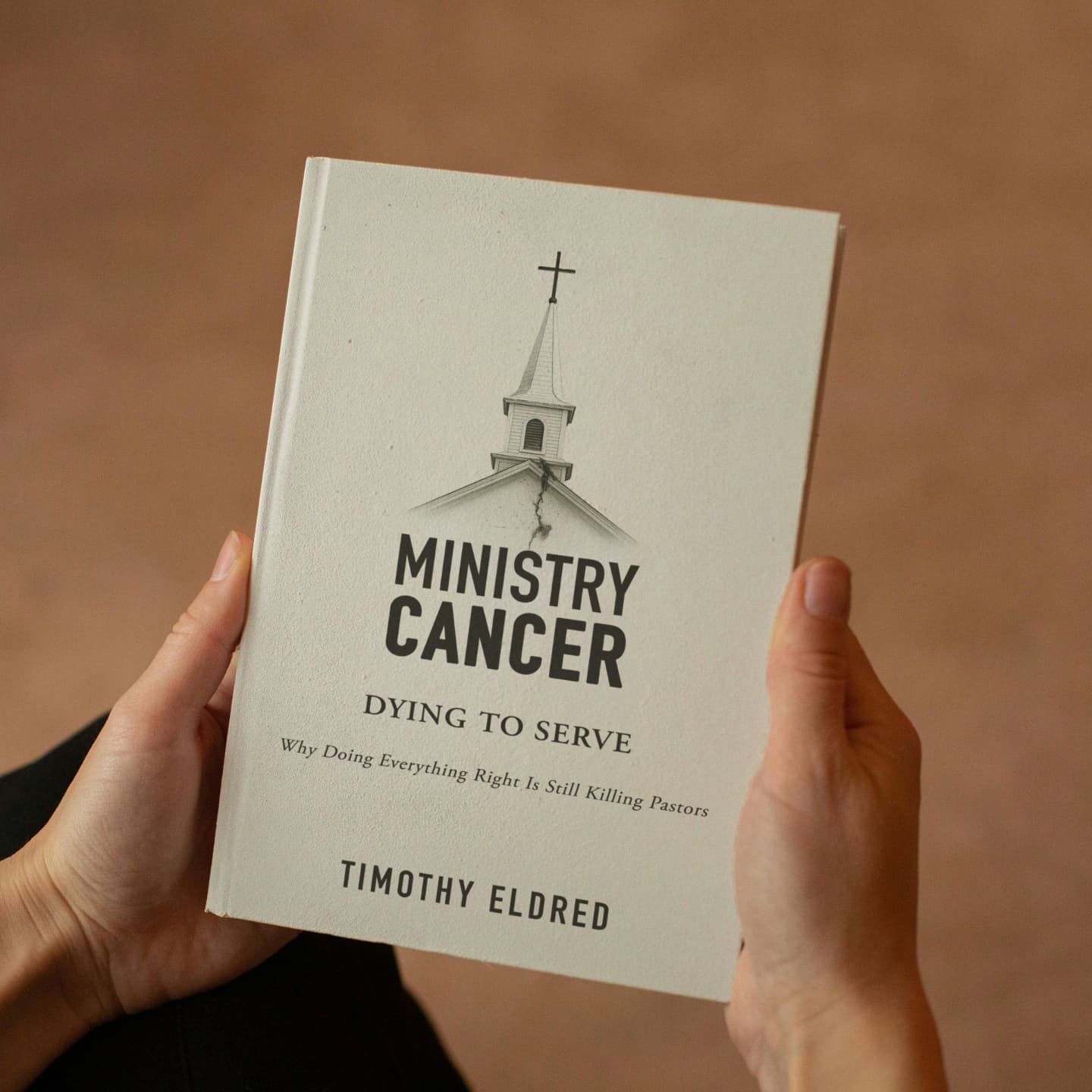
Most of us are. The conditioning runs deeper than we realize. That's exactly why I wrote Ministry Cancer: Dying to Serve—to name the patterns we keep reproducing before they get handed to one more generation. Free for pastors right now.
→ Get Your Free Copy of Ministry Cancer
ABOUT THE AUTHOR
Tim Eldred has been serving in pastoral ministry for over three decades and has had the privilege of training and mentoring thousands of pastors in over 40 countries. He is the founder of The Authentic Pastor. Most importantly, he is a husband, father, and grandfather.